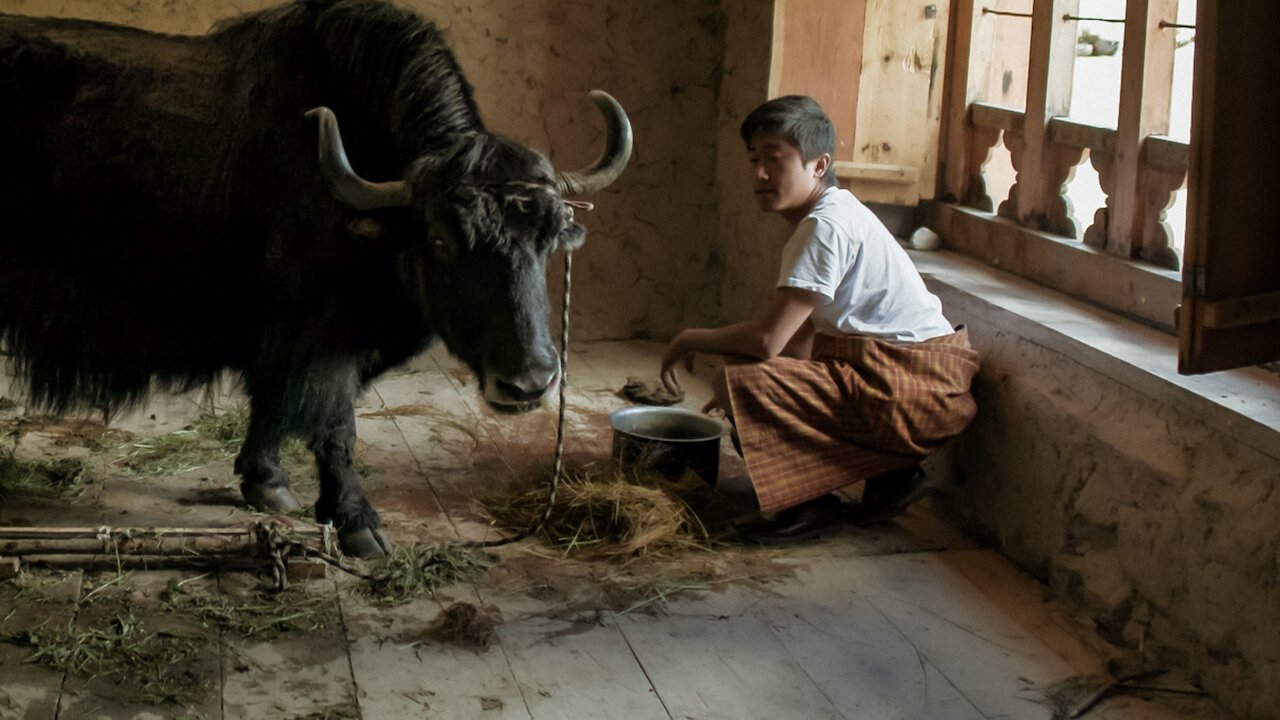
Pawo Choyning Dorji’s *Lunana: A Yak in the Classroom* (2019) is a quiet but deeply affecting film about education, modernity, cultural identity, and the gradual rediscovery of human purpose. Set between the urban life of Bhutan and the isolated Himalayan village of Lunana, the film follows Ugyen, a young teacher who dreams of leaving Bhutan and moving to Australia to become a singer. Uninterested in his profession and dissatisfied with his ordinary life, he sees teaching as an obstacle rather than a meaningful responsibility. When he is sent to Lunana, an extremely remote mountain village, his journey becomes more than a change of location. It becomes a confrontation between his ideas of success and a completely different understanding of happiness.
The central conflict of the film is created through the contrast between modern ambition and traditional communal life. At the beginning, Ugyen represents a generation attracted by the possibilities of a wider world. He wants music, travel, Australia, and a future beyond the limitations of his present life. His dream is not presented as foolish. The desire to explore the world and choose one’s own future is understandable. However, the film gradually asks whether the modern idea of success has made Ugyen unable to recognize the value of what already exists around him.
Lunana represents the complete opposite of the urban life Ugyen wants to escape. Reaching the village requires a difficult journey through the mountains, and once he arrives, he discovers a school without the facilities he considers necessary for education. There is no modern classroom, no electricity, and none of the comforts that define his previous life. His first reaction is frustration. He feels that he has been removed from civilization and placed in a world where his ambitions cannot survive. Yet this reaction reveals one of the film’s most important ideas: what one person considers deprivation may not be experienced in the same way by another.
The villagers of Lunana are poor in material terms, but the film refuses to define them simply through poverty. They possess strong social relationships, cultural traditions, and a profound sense of community. Their lives are difficult, but their difficulties do not eliminate their dignity. This distinction is essential to the film’s criticism of modern values. *Lunana: A Yak in the Classroom* does not argue that poverty is beautiful or that hardship should be romanticized. Instead, it questions the assumption that technological development and material comfort automatically produce a better or more meaningful life.
Education is at the heart of this conflict. Ugyen initially believes that he cannot teach because he lacks the physical tools of education. The school has almost nothing. However, the children’s enthusiasm gradually forces him to reconsider what teaching actually means. Their desire to learn contrasts sharply with his own lack of interest in being a teacher. For Ugyen, education was a profession he wanted to escape; for the children of Lunana, it represents an opportunity. This reversal becomes one of the film’s strongest critical observations.
The film suggests that education cannot be reduced to classrooms, textbooks, technology, or formal institutions. These things are valuable, but they are not the only foundations of learning. Ugyen gradually discovers that teaching begins with human connection. He must learn how to communicate, improvise, listen, and respond to the needs of his students. In the process, the teacher himself becomes a student. The children teach him patience, responsibility, and the importance of being present in the lives of others.
This transformation is deliberately quiet. The film avoids dramatic speeches and sudden revelations. Ugyen does not experience a single moment that completely changes his life. Instead, his transformation develops through small experiences: his relationship with the children, the generosity of the villagers, the landscape surrounding him, and the gradual disappearance of the comforts he once depended upon. The slow pace reflects the central theme of the film. Personal change does not always happen through extraordinary events. Sometimes it happens when a person is removed from familiar routines and forced to pay attention to a different way of living.
The landscape plays an important role in this process. The Himalayan environment is not simply a beautiful background for the story. It creates the conditions that shape the characters’ lives. The mountains are majestic, but they are also difficult and isolating. Nature in the film cannot be controlled in the same way as urban life. Ugyen must adapt to his environment rather than expecting the environment to adapt to him. This creates a significant contrast with his earlier life, where modern comforts allowed him to move through the world without thinking about his dependence on technology and infrastructure.
The beauty of Lunana therefore has a complicated meaning. It offers peace and spiritual space, but it also exists alongside physical hardship. The film is strongest when it allows both realities to remain visible. The village is not presented as a perfect paradise untouched by the problems of the modern world. Its people face isolation and limited access to resources. At the same time, their community possesses forms of connection that Ugyen’s urban life seems to lack. The film asks viewers to consider what may be lost when societies pursue development without considering relationships, culture, and emotional well-being.
Music also becomes an important symbol throughout the story. Ugyen dreams of becoming a singer, and music represents his desire for another life. At first, his dream of singing appears to be connected to escape. He wants to leave his current responsibilities behind and pursue a more individual form of success. However, as his relationship with Lunana develops, music takes on a different meaning. It becomes connected to memory, community, and emotional communication. The contrast between these meanings suggests that art can either be imagined as a path toward personal ambition or experienced as something that connects individuals to a larger human community.
The film’s use of the yak is also more significant than its unusual title initially suggests. The animal becomes part of the classroom and represents the practical relationship between the community and its environment. In the world of Lunana, human life is closely connected to animals, weather, land, and tradition. The yak is not presented merely as a humorous or exotic element. Its presence reminds the viewer that education takes place within a specific social and environmental reality. A classroom cannot be separated completely from the world surrounding it.
One of the most interesting aspects of the film is its treatment of cultural identity. Ugyen initially looks outward. His imagination is directed toward Australia and a future beyond Bhutan. Lunana forces him to look inward, not necessarily by rejecting the outside world but by reconnecting him with a part of his own country that he has failed to understand. The village is geographically distant from the modern city, but it is also culturally distant from Ugyen’s way of thinking. His journey therefore becomes a journey toward his own society.
This is particularly important because the film avoids presenting globalization as entirely negative. Ugyen’s dream of Australia is not portrayed as a moral failure. The film understands why young people may seek opportunities elsewhere. However, it questions whether leaving one’s home automatically means finding freedom or happiness. By placing Ugyen between two possible futures, the film explores the tension experienced by many people in a rapidly changing world: the desire to participate in modern global culture while also maintaining a connection with local identity and community.
The film’s gentle style is one of its greatest strengths, although it can also be considered a limitation. Its narrative is simple, and Ugyen’s transformation is relatively predictable. From the moment he arrives in Lunana, the audience can expect that the children and villagers will gradually change him. There are few major surprises in the structure of the story. However, the emotional power of the film does not depend on narrative complexity. Its strength lies in the sincerity of its observation.
Rather than constructing an elaborate plot, Pawo Choyning Dorji focuses on atmosphere and relationships. The quietness of the film becomes a form of resistance against the fast pace of modern entertainment. In a cinematic culture often dominated by spectacle, conflict, and constant stimulation, *Lunana: A Yak in the Classroom* asks the audience to slow down. It creates meaning through silence, landscape, music, and ordinary human interaction. This approach may appear simple, but its simplicity is carefully connected to the film’s larger argument about the value of attention.
At the same time, the film can occasionally romanticize rural life. The warmth and generosity of the villagers are deeply moving, but the narrative gives relatively little attention to the structural difficulties that make life in such a remote community challenging. The absence of modern facilities becomes an opportunity for Ugyen’s personal growth, but for the people who permanently live in Lunana, these conditions are not temporary experiences. This creates an important critical question: does the film sometimes transform the hardships of rural life into a spiritual lesson for an educated outsider?
This criticism does not destroy the film’s central message, but it makes the message more complex. Ugyen has the privilege of entering Lunana and eventually leaving it. The villagers do not experience the village as an escape from modern life in the same way that he does. For them, it is home. The difference between these perspectives is important because it prevents the audience from simply concluding that traditional life is morally superior to modern life. The film is more interesting when understood as an exploration of balance rather than a rejection of progress.
The ending of the film reinforces this ambiguity. Ugyen’s experience in Lunana has transformed his understanding of himself, but the question of what he will ultimately choose remains connected to his earlier ambitions. The film does not provide a simplistic answer that demands he permanently abandon one world for another. Instead, it suggests that his journey has given him a new way of seeing both worlds. The real transformation is not simply that he chooses the mountains over the city. It is that he can no longer understand success in exactly the same way.
Ultimately, *Lunana: A Yak in the Classroom* is a film about learning to recognize value beyond material ambition. Its most powerful argument is that education is not a one-directional process in which a teacher gives knowledge to students. Ugyen arrives in Lunana believing that he is the educated person who has come to teach others. By the end, he has learned that education can transform the person who teaches just as deeply as the people who are taught.
The film also challenges modern assumptions about happiness. Wealth, technology, travel, and individual ambition may create opportunities, but they do not automatically create meaning. Through Ugyen’s journey, Pawo Choyning Dorji asks what happens when a person achieves the freedom to leave but begins to question what he is leaving behind. The answer offered by the film is not that one should reject the modern world or abandon personal dreams. Rather, it suggests that ambition without connection can become empty.
*Lunana: A Yak in the Classroom* is therefore a simple story with a significant critical purpose. It examines the relationship between education and responsibility, modernity and tradition, individual desire and communal belonging. Its quietness is not a weakness but an essential part of its method. The film does not force its ideas upon the audience through dramatic conflict. Instead, it invites reflection through the gradual transformation of one teacher who travels to a distant village and discovers that the world he considered remote may understand something about life that he had forgotten.
In the end, the film’s deepest question is not whether Ugyen should remain in Lunana or leave for another country. The more important question is whether any journey can provide happiness if a person does not understand what happiness means. By placing a reluctant teacher in one of the world’s most isolated communities, *Lunana: A Yak in the Classroom* transforms a story about a classroom into a broader reflection on purpose, belonging, and the education that life itself can provide.
“Education is not simply about teaching others; sometimes the greatest lesson is discovering what life itself has to teach us.”
Tags: Lunana, A Yak in the Classroom, Pawo Choyning Dorji, Bhutanese Cinema, Film Criticism, Education, Modernity, Happiness, Cultural Identity