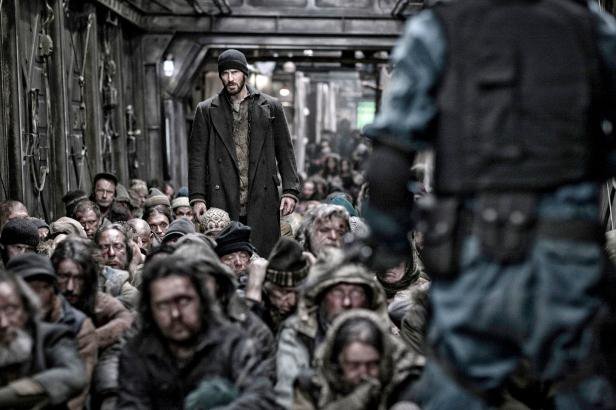
Bong Joon-ho’s Snowpiercer (2013) is a striking dystopian science-fiction film that transforms a simple physical space—a train moving endlessly through a frozen world—into a powerful metaphor for social inequality, political control, and the violence required to maintain an unequal system. Based on the French graphic novel Le Transperceneige, the film imagines a future in which humanity’s attempt to reverse climate change causes a catastrophic global ice age. The remaining survivors live aboard the Snowpiercer, a self-sustaining train divided according to class. Those at the front enjoy luxury, education, entertainment, and abundance, while those at the tail live in extreme poverty and are treated as expendable.
Through this confined world, Bong Joon-ho creates an exaggerated but recognizable image of society in which wealth, power, and resources are concentrated among a privileged minority while the majority are expected to accept suffering as the natural order of life. The train becomes more than a setting; it represents an entire political and economic system built on hierarchy.
The most important symbol in Snowpiercer is the train itself. Every passenger is assigned a particular place, and the ruling class constantly insists that everyone must remain in that place. The physical structure of the train therefore represents a social hierarchy. The further forward one travels, the greater the wealth and privilege become. The tail section is crowded, dark, and deprived, whereas the front contains extravagant spaces of consumption and comfort. Bong does not allow class division to remain an abstract concept; he turns it into architecture.
The rebellion led by Curtis initially appears to follow a familiar revolutionary narrative. The oppressed rise against their oppressors and attempt to seize control of the system. However, Bong complicates this simple story by questioning whether replacing the people at the top can truly produce freedom. Curtis’s journey toward the engine gradually reveals that the system is more deeply controlled than he imagined. Even rebellion can become part of the system it is trying to destroy.
Wilford, the creator and ruler of the train, represents the ideology behind this oppressive system. His power depends on presenting inequality as a necessity. He argues that every part of the train must perform its assigned function in order for humanity to survive. This language of “order” and “necessity” becomes a justification for cruelty. The poor must suffer because the system supposedly requires it, and human lives can be sacrificed in the name of efficiency.
The film therefore exposes the danger of a political order in which efficiency becomes more important than human dignity. Wilford does not see himself as simply evil. Instead, he believes that his brutality is rational and necessary. Bong Joon-ho shows how systems of power often disguise human choices as unavoidable laws, making oppression appear natural.
Curtis is also more complicated than a conventional action hero. Although he leads the rebellion, he is haunted by his violent past and does not possess the moral purity usually associated with cinematic revolutionaries. His confession about the early days of life on the train reveals how extreme conditions can destroy ordinary ethical boundaries. Bong therefore refuses to separate victims and perpetrators completely. Oppression produces suffering, but it can also produce violence among the oppressed themselves.
One of the film’s greatest strengths is its visual storytelling. As Curtis and his group move through the train, each compartment reveals another aspect of the society they are fighting against. The classroom demonstrates how power reproduces itself through education and propaganda. Children are taught to admire Wilford and accept the existing social order as something sacred and necessary. The cheerful atmosphere makes the scene even more disturbing because violence and political control are hidden beneath celebration and discipline.
The people at the front of the train enjoy luxury, entertainment, and abundance while remaining largely disconnected from the suffering behind them. They do not need to participate directly in oppression because the system has made the suffering of the poor almost invisible. Different classes exist within the same train but experience completely different realities.
Snowpiercer is also notable for Bong Joon-ho’s mixture of genres and tones. The film combines science fiction, action, horror, black comedy, and political satire. At times, its exaggerated characters and absurd humour appear almost incompatible with its serious subject. However, this contrast is central to Bong’s style. The absurdity makes the social order appear both ridiculous and terrifying.
Minister Mason is a particularly strange and theatrical representative of authority. Her exaggerated behaviour exposes the artificial nature of power. Authority often depends on performance, ceremony, language, and the repeated demand that people accept ideas that are fundamentally irrational. Bong’s mixture of humour and brutality makes the political criticism more uncomfortable and memorable.
However, Snowpiercer is not without limitations. Its metaphor of class division is extremely direct and sometimes overly simplified. The rich are located at one end, the poor at the other, and the physical distance between them makes the symbolism impossible to miss. This simplicity gives the film enormous visual power, but real social structures are often more complicated than the clear division presented in the film.
Nevertheless, the ending gives the film its most radical political message. After Curtis reaches the engine, he is offered the possibility of replacing Wilford and becoming the new leader of the train. At this moment, the conventional revolutionary story is rejected. Curtis could destroy one ruler and become another, preserving the structure while simply changing the person in control.
Namgoong offers a more dangerous alternative. Rather than taking control of the train, he wants to leave it. His decision to destroy the system is based on the belief that survival outside the established order may be possible. The destruction of the train therefore represents both an ending and a beginning. It creates uncertainty, but it also makes genuine freedom possible.
The final image of the surviving children encountering a polar bear is particularly significant. Throughout the film, the passengers have been taught that the world outside the train is completely dead and that the train is the only possible form of life. The polar bear proves that this belief is false. Life exists beyond the boundaries imposed by the system.
Ultimately, Snowpiercer argues that oppressive systems survive not only through violence but also through the imagination of the people living inside them. People must be convinced that the existing order is natural, necessary, and eternal. The discovery of life outside the train destroys this illusion and suggests that another world is possible.
As a critical work, Snowpiercer remains powerful because its dystopian future reflects recognizable conditions of the present. Its concerns about climate catastrophe, economic inequality, resource distribution, labour exploitation, propaganda, and political violence remain deeply relevant. Bong Joon-ho does not offer an easy solution. Revolution is shown as bloody, leadership is morally complicated, and the destruction of the existing system creates uncertainty rather than immediate happiness.
Snowpiercer is therefore more than a science-fiction action film. It is a disturbing examination of the ways societies organize inequality and justify suffering. At the same time, it challenges audiences to imagine life beyond systems that claim to be the only possible world. Its final message is both frightening and hopeful: sometimes genuine change requires more than taking control of the machine—it requires finding the courage to leave it behind.